Characters in Middlemarch
Arthur Brooke
Arthur Brooke is the aging proprietor of the Brooke estate and guardian to his nieces Dorothea and Celia. A gentleman of independent means and moderate social standing in Middlemarch, he cuts an unimpressive figure—his thinning hair, ruddy complexion, and soft manner give him an air of genial but scatterbrained authority. Brooke is fond of his role as a country squire and harbors ambitions toward political life, though his convictions shift with the winds. His conversation is famously digressive; he begins one topic, abandons it, circles back, and rarely concludes a thought with force. Though not unkind, his wandering attention extends to his estate management, and his tenants suffer the consequences of his neglect. He respects Dorothea's intellect—particularly her interest in serious books and improvement schemes—yet his own grasp of systematic reform is shallow. He is frequently caught between liberal pretensions and the comfortable conservatism of his class, making him a figure of mild ridicule among both reformers and traditionalists in the county.
Dorothea Brooke
Dorothea Brooke is the elder daughter of a Middlemarch gentleman of independent means, raised in comfortable but intellectually stimulating circumstances. She is well-educated for a woman of her time, fluent in languages and interested in classical learning, theology, and abstract philosophy—interests that mark her as unusual and somewhat peculiar in her social sphere. Her mother is deceased, and she lives with her uncle, Mr. Brooke, and her younger sister Celia in the family home at Tipton. Dorothea has rejected the ordinary pleasures and pursuits expected of young women of her class; she finds talk of dress, flirtation, and marriage frivolous, and she aspires instead to a life of serious purpose and intellectual companionship. She is deeply religious, though her piety tends toward the austere and the reforming rather than the merely conventional. Her relationships are marked by an intensity of feeling and a tendency toward idealization; she seeks in those around her—particularly men she perceives as wise or learned—qualities that perhaps exist more fully in her imagination than in reality. Her situation places her in constant tension between her own aspirations and the expectations of her family and society.
Edward Casaubon
Edward Casaubon is a reclusive scholar in his fifties who has spent most of his adult life at Lowick Manor pursuing his monumental theological work. Learned but narrow in his intellectual range, he represents the old guard of provincial scholarship—erudite yet increasingly obsolete, meticulous yet emotionally stunted. He is prone to hypochondria and suffers from real health anxieties that he nurses carefully. Casaubon moves through Middlemarch society with formal courtesy, but his reserve and lack of genuine warmth keep him largely isolated, even when he marries. He values propriety, classical knowledge, and the respect due to his station and learning, yet feels increasingly threatened by younger, more vigorous minds and by the dawning awareness that his magnum opus may never achieve the significance he imagines for it. Those who know him recognize in him a cautionary figure: a mind of real ability trapped by its own rigidity, unable to adapt, connect authentically, or find peace in his work.
Fred Vincy
Fred Vincy is a young gentleman of Middlemarch, the son of a prosperous manufacturer and brother to the lovely Rosamond. Educated at an academy and groomed for a respectable future, Fred embodies the careless charm and sporting enthusiasms of privileged youth. He is known for his love of horses, his ready laugh, and his affable manner in society—qualities that endear him to many, even as they sometimes mask a deeper uncertainty about his own path and character. Fred has long harbored sincere affection for Mary Garth, the intelligent and principled daughter of Caleb Garth, though their attachment faces obstacles both practical and social. His life takes an unexpected turn when family fortune and expectation prove less stable than he had assumed, forcing him to confront questions of integrity, obligation, and what he truly values. Beneath his surface geniality lies a capacity for genuine feeling and, when circumstances demand it, for growth. He finds himself caught between the world of privilege and leisure into which he was born and an emerging awareness that happiness and esteem may require effort and sacrifice beyond the comfortable defaults of his youth.
James Chettam
James Chettam is the comfortable master of Freshitt, commanding several hundred acres and the respect of his county. A man of steady habits and uncomplicated values, he concerns himself with estate management, proper marriages, and the maintenance of order among his tenants and neighbours. He is not given to reading or intellectual pursuits, but he is a loyal friend to those he values and a firm believer in family obligation and social decorum. His wealth and position afford him considerable influence in local affairs, which he wields with a benevolent hand and an expectation that others will defer to his judgment in matters of propriety. Though he may seem content with the surface of things, he possesses a genuine kindness that endears him to those nearest to him.
Mary Garth
Mary Garth is a young woman of quiet strength and uncommon good sense, living at Lowick as a companion and helper to her uncle Peter Featherstone while her father, Caleb Garth, manages his estates. Devoted to her family and conscious of their modest but respectable standing in the parish, she brings order and care to the household. She is deeply attached to her parents and siblings, and particularly protective of her younger brother Fred Vincy, whose earnestness and occasional follies she views with affectionate exasperation. Her friendship with Dorothea Brooke, whom she meets through connection to Lowick, represents a meeting of minds across the boundaries of social class—both women share an appetite for serious thought and genuine feeling. Mary possesses a rare clarity of vision about the world and the people in it; she neither flatters nor deceives, but speaks and acts according to her conscience. Her refusal to be swayed by flattery or social pressure, even when it concerns matters that touch her own heart, demonstrates a constancy of principle that marks her as someone of genuine moral fiber. She finds meaning in useful work, in loyalty to those she loves, and in the quiet pursuit of a life lived honestly.
Nicholas Bulstrode
Nicholas Bulstrode has built a formidable position in Middlemarch through a combination of business acumen, strategic marriage to the wealthy widow Harriet Vincy, and unwavering religious conviction. As the town's leading banker and a prominent supporter of the new hospital project, he wields considerable influence over local affairs and takes his role as moral arbiter of the community with grim seriousness. His marriage to Harriet has given him entrée into respectable society, though he views even her family connections with a critical eye, particularly when he perceives lapses in moral rigor. He is a devoted supporter of the Evangelical cause and uses his wealth to advance what he believes are righteous works—the hospital, the chapel, various charitable schemes—yet his manner is cold and calculating rather than warm. Bulstrode has few genuine friendships; those around him respect his position and fear his moral judgments, but few warm to him personally. He maintains strict control over his household and expects absolute compliance with his religious standards, and he regards with particular suspicion anyone whose lifestyle or reputation suggests indulgence or unconventional behavior.
Rosamond Vincy
Rosamond Vincy is the belle of provincial Middlemarch, raised in comfort as the daughter of a successful ribbon manufacturer. Trained in all fashionable accomplishments—particularly music and drawing—she has cultivated a reputation as one of the town's most elegant and attractive young ladies. She harbors ambitions to marry well and elevate her family's standing, and she pursues these aims with a calm, deliberate strategy masked by an appearance of feminine passivity. Her charm is genuine but often deployed with calculation; beneath her soft voice and graceful demeanor lies a will as unyielding as iron when crossed. She commands attention in drawing-rooms and receives constant admiration, yet remains largely indifferent to the feelings of those who orbit her, viewing them primarily as either useful or obstacles to her own designs. Her world is one of aesthetic refinement and social positioning, and she moves through it with an artist's attention to effect.
Sir James Chettam
Sir James Chettam is a country gentleman of considerable standing, owning a substantial estate in Loamshire and possessed of a respectable fortune and good family name. He is known throughout the parish as honest, generous, and genuinely concerned for the welfare of his tenants and neighbours—a responsible landowner who takes an active interest in improvements to his land. Though well-educated in the manner expected of his rank, his mind runs toward practical matters rather than abstract speculation; he is a man of steady principles and straightforward judgment. His social position is unquestioned, and he moves comfortably in county society, where he is regarded with approval. He occupies himself with the ordinary pursuits of a country gentleman—riding, estate management, and the social duties of his station—and he brings to these activities a sincere desire to do right by those dependent upon him. His candour and openness make him respected, if not always intellectually stimulating, and his genuine affection for those around him is evident in his actions and bearing.
Tertius Lydgate
Tertius Lydgate arrives in Middlemarch as a young man of promise—a physician trained in the latest medical methods, fluent in scientific inquiry, and animated by genuine hopes of advancing medical knowledge and practice. He is drawn to the town partly by the chance to pursue uninterrupted research, partly by the prospect of establishing himself professionally. His conversation sparkles with technical knowledge and idealistic conviction; he speaks with the confidence of someone educated beyond the provincial sphere. Yet beneath his professional assurance lies a romantic nature and a susceptibility to social regard that complicates his path. He forms connections across Middlemarch society—with fellow reformers, with the Reverend Farebrother, with patients and their families—but finds himself increasingly entangled in emotional and financial difficulties that test his resolve. Though capable and well-intentioned, he struggles between the demands of worldly success and the purity of scientific ambition, caught between the man he wishes to become and the circumstances that press upon him.
Will Ladislaw
Will Ladislaw is a young man of considerable charm and intellectual vivacity who brings an unsettling cosmopolitan energy into Middlemarch society. Raised partly abroad and shaped by Continental influences, he possesses a genuine love of art, literature, and progressive ideals that sets him apart from the conventional gentry. He lacks clear direction or independent means, which makes him both romantically compelling and socially precarious—he is accomplished enough to seem promising, yet adrift enough to appear frivolous to more settled minds. His relationship with the elderly scholar Mr. Casaubon is complex and tinged with mutual wariness, while his encounters with other characters—particularly those of intellectual or moral seriousness—expose both his genuine sensibility and his occasional immaturity. Will's fundamental decency and capacity for real feeling coexist with a tendency toward impulsive action and a need to define himself against the expectations of others. He is drawn to meaningful work and authentic connection, yet struggles with the weight of family history and the practical demands of an uncertain position.
Caleb Garth
Caleb Garth stands at the heart of Middlemarch's working and professional classes as a surveyor and land agent of unquestioned integrity. Married to Susan (née Farebrother), he has raised a family of capable children while maintaining contracts with several local landowners and conducting his own small farming operations. His life is animated by a love of work itself—not for wealth or status, but for the genuine satisfaction of doing things competently and honestly. He takes pride in teaching his children the principles of sound management and ethical conduct, and he maintains warm relations with many of Middlemarch's notable families through his professional dealings. Though he lacks the education of clergymen or physicians, his judgment is trusted by those who know him, and his presence in the town represents the backbone of its respectable middle class. His relationship with the Vincy and Featherstone families connects him to several of the novel's central entanglements, and his steady character serves as a quiet moral counterweight to the ambitions and complications of those around him.
Celia Brooke
Celia Brooke is the younger daughter of Mr. Brooke, a landed gentleman of Middlemarch. Uncomplicated and cheerful by nature, she finds contentment in the ordinary pleasures of her position—fine needlework, pleasant social company, and the natural beauty of the Midlands countryside. She adores her elder sister Dorothea but is frequently bemused by Dorothea's intellectual intensity and self-denying principles. Celia is frank and affectionate, without pretense, and approaches life with a kind of untroubled common sense. She lives at Tipton, the Brooke family estate, and participates fully in the domestic and social life of the neighbourhood. Where Dorothea seeks to reform the world through serious moral effort, Celia accepts things much as they are, secure in the warmth of family affection and the modest satisfactions of her station.
John Raffles
John Raffles is a man of dissipated habits and vagrant character, a living emblem of ruin and consequence. He drifts into Middlemarch bearing knowledge of past misdeeds and indiscretions that others have sought to bury, wielding that knowledge as a tool of extortion and social leverage. His presence disrupts the carefully maintained facades of respectability that govern the town's ostensible moral order. Raffles trades in secrets and blackmail, moving through Middlemarch's underworld as an unwelcome reminder of roads not taken and debts unpaid—not merely financial, but moral and personal. His capacity to inflict damage stems not from any position of genuine power but from his intimate knowledge of compromises and concealments that bind his victims to shame. He represents the danger that the past, once thought safely buried, can resurface to unmake the present.
Mrs. Cadwallader
Mrs. Cadwallader is the spirited wife of the Rector of Freshitt parish, a woman of established standing in Middlemarch's respectable society. She takes an active, if sometimes acerbic, interest in the affairs of those around her, particularly the young people of good family. Her parlour is a gathering place for social news and her opinions are offered with bracing directness—she does not suffer fools gladly, nor does she shy away from frank speech about the follies and pretensions she observes in those she knows. Though she can be caustic and unforgiving, her judgments often prove sound, rooted in a practical understanding of human nature and social reality. She is deeply attached to her own family and their standing, protective of her husband's reputation and interests, and capable of both genuine warmth and steely disapproval depending on whether she views a person or action as sensible or as a threat to good order.
Peter Featherstone
Peter Featherstone is a wealthy landowner of advanced age and considerable property in Middlemarch, accustomed to wielding his fortune as an instrument of authority over his extensive circle of relatives and dependents. Living at Stone Court, his country house, he occupies a dominant position in local society by virtue of his financial standing, though his increasing infirmities have begun to confine him more frequently to his chair. His interactions with his numerous relations—nephews, nieces, and their spouses—are characterized by a sardonic pleasure in manipulating their hopes and anxieties regarding his inheritance; he is moved by neither affection nor principle, but rather by a cold appreciation for the entertainment value of watching people scramble for his favor. He is shrewd in financial matters and takes a keen interest in the proceedings of others' lives insofar as they might affect his own comfort or amusement. Though his health visibly declines as the novel progresses, his mind remains sharp and his capacity for acid comment undiminished, making him a figure both feared and grudgingly respected within his family circle and in local society at large.
Walter Vincy
Henry Vincy is a man of the middle station in Middlemarch society—prosperous enough through manufacturing and trade to occupy a respectable place among the county gentry, yet not of the landed or professional classes that command the highest social rank. He is the father of the beautiful Rosamond and the headstrong Fred, and he devotes considerable energy to securing advantageous matches and positions for them. Fond of good living, he is not niggardly in his expenditures on his family's comfort and appearance, though he is apt to grumble when expenses exceed his expectations or when his children's choices threaten his plans. He stands in relation to his wife as the one who makes the final decisions on matters of family finance and consequence, though he often yields to her persuasions in matters of domestic management. His view of clergymen, gentlemen, and professional men is seasoned by his experience as a tradesman, giving him a certain shrewdness about character mixed with a provincial confidence in his own judgment.
William Farebrother
William Farebrother serves as the vicar of St. Botolph's in Middlemarch, a position that affords him modest means and considerable spiritual responsibility. He is a man of genuine learning and conscience, devoted to both his clerical duties and to scholarly pursuits in classics and natural history—pursuits that might have led to academic distinction had his circumstances permitted. Though of respectable family, his modest income and lack of ambitious connections leave him in an economically precarious position, dependent on the goodwill of his patrons and the modest stipend of his curacy. He lives in Middlemarch with his mother and sister, both of whom depend upon him, and he is known throughout the town for his kindness, his lack of pretension, and his genuine interest in the welfare of those around him. His quiet intelligence and moral seriousness command respect among those who know him well, though he is often overlooked by those seeking advancement or social consequence. He moves through Middlemarch society with a self-effacing grace, offering counsel and friendship without expectation of return, and bearing his own disappointments with a stoicism that speaks to both his faith and his acceptance of his station.
Edward Waule
Edward Waule is a prosperous Middlemarch tradesman whose identity is wholly bound up with commercial success and family connection. As a man of business, he commands respect within the town's mercantile circles and takes pride in his social standing. He is connected through marriage to several of Middlemarch's more prominent families, though his own commercial roots mark him as fundamentally different from the gentry class. Waule's worldview is shaped entirely by considerations of profit, property, and material security. He takes a keen, calculating interest in the affairs and fortunes of his relations, ever attentive to questions of who inherits what and how family circumstances might shift. His presence in social gatherings is that of a man confident in his own standing and untroubled by any sense of intellectual or cultural limitation. Waule embodies the solid, unimaginative prosperity of Middlemarch's merchant class—respectable, shrewd, and fundamentally indifferent to any concerns beyond the material and the familial.
Harriet Bulstrode
Harriet Bulstrode occupies an uneasy position as the wife of one of Middlemarch's most prominent citizens. Married young to Nicholas Bulstrode, she has spent her adult life managing a comfortable household while contending with her husband's stern moral judgments and domineering presence. Though she enjoys the material security his banking wealth provides, Harriet's life is constrained by both her husband's controlling nature and the narrow sphere permitted to respectable wives of her social rank. She moves through Middlemarch society with outward compliance, yet her guarded manner and anxious demeanor hint at deeper frustrations. Harriet has learned to navigate her marriage through a combination of meek acquiescence and private resignation, making her a figure of sympathetic restraint—a woman whose quietness conceals the accumulated weight of subordination and thwarted independence.
Humphrey Cadwallader
Humphrey Cadwallader is a country gentleman of settled years and established station, living in the neighbourhood of Tipton with his wife, the more forceful and socially acute Mrs. Cadwallader. A man of property and moderate influence, he participates in the social and political life of the provincial gentry with an easy confidence born of long habit and unchallenged position. He takes interest in the affairs of his neighbours—marriages, inheritances, preferments—with the leisured attention of someone who has neither urgent necessity nor great ambition to drive him. His manner is affable and open, his judgement generally sound if somewhat conventional; he tends to follow his wife's lead in matters requiring sharper discernment, and is content to act as her amiable companion in her observations of local society. He is neither intellectually pretentious nor deliberately stupid, but rather a solid, unpretending figure of the provincial English gentry, secure in his place and reasonably satisfied with his understanding of the world as it is.
Joshua Rigg
Joshua Rigg is a young man navigating life on the margins of respectability in provincial England. Of limited social standing but considerable ambition, he has attached himself to connections that might secure his future—most notably his relationship with the elderly and wealthy Peter Featherstone. Rigg is shrewd and observant, with a calculating temperament that allows him to read situations and people with sharp intelligence. He is not a man of warmth or open feeling, but rather someone who moves through the world with careful deliberation, always alert to opportunities for advancement. His presence in the narrative reveals the intricate web of financial dependence, inheritance expectation, and social maneuvering that characterizes provincial life.
Lucy Vincy
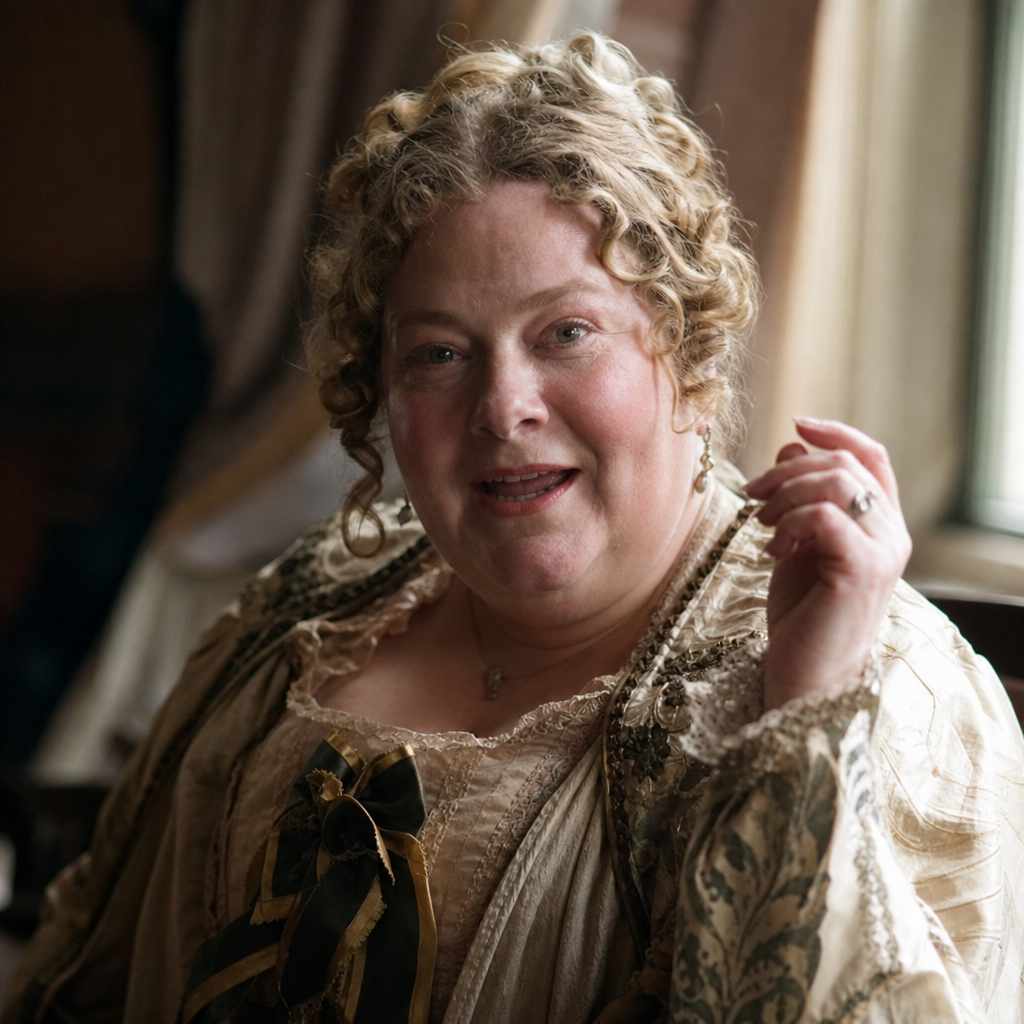
Frances Vincy is a prosperous merchant's wife living in Middlemarch during the 1820s-1830s. The mother of the charming and irresponsible Fred and the beautiful but self-centered Rosamond, she is devoted to seeing her children well-established in life, though her vision of success is firmly rooted in social standing and financial security. She takes considerable pride in her family's position and in Rosamond's accomplishments as an accomplished young woman. Her chief occupations are the management of her household, the maintenance of her social connections, and the oversight of her children's prospects. She is fond of her husband and loyal to her family, but her perspective is limited by the conventional attitudes of her time and class; she moves through society with the assumption that respectability and good marriages are the highest goods. Her judgments of others are often colored by their utility to her family's interests or their standing in the social hierarchy. She inhabits a world of domestic concerns and neighborhood gossip, and is largely indifferent to the intellectual and moral questions that trouble more thoughtful characters in the novel.
Mr. Wrench
Mr. Wrench has been the leading medical man of Middlemarch for years, commanding the trust of many prominent families through consistent service and conventional practice. He is comfortable in his position and practices medicine according to established principles, having no incentive to embrace the newer theories that Dr. Lydgate brings to the town. Wrench moves through Middlemarch's drawing rooms and sickbeds with the assurance of someone who has long held the confidence of the gentry and professional classes. His interactions with other medical practitioners are colored by professional rivalry and the protective instinct of an established practitioner watching a younger man arrive with ambitious ideas and modern training. Wrench represents the forces of local custom and professional convention, a reasonable but unambitious man whose primary concerns are maintaining his practice and his standing in the community.
Solomon Featherstone
Solomon Featherstone is a substantial figure in Middlemarch's social and civic hierarchy, a man whose fortune and position rest upon inherited land and long-established connections. He takes his role as a magistrate and gentleman of property with utmost seriousness, though his decisions tend toward the conservative and are frequently colored by his concern for maintaining the status quo and his own standing in society. He maintains strong opinions on matters of public concern and is not hesitant to voice them, often with the confident assumption that his view reflects the proper order of things. His interactions with others reveal a man invested in the preservation of traditional structures and wary of innovation or change that might disturb the social arrangement he has always known.
Susan Garth
Susan Garth lives within the prosperous but unpretentious Garth household, where her father manages estates and her mother oversees a well-ordered domestic economy. As the eldest daughter, she has grown into a capable, serious-minded young woman who takes genuine interest in the welfare of her younger siblings and the smooth functioning of the household. Unlike some of her contemporaries, Susan possesses no romantic illusions or yearnings for fashionable society; her character is solidly grounded in duty, practical sense, and quiet moral conviction. She is known for her straightforward manner and her genuine concern for the real welfare of those around her—a steadiness that marks her as reliable and trustworthy within her own modest sphere.